


The rate you signed up for is not the rate you're paying
Go get your last electric bill. Not the email summary, the actual bill with the line items on it.
Find two numbers. The total you paid, and the kilowatt hours you used. Divide the first by the second.
That number is what you actually pay for electricity. It is almost never the number you signed up for.
Work out your real rate
Two numbers off your last bill. Nothing gets sent anywhere, this runs in your browser.
—¢ per kWh, all in
Where the gap comes from
When you picked your plan on Power to Choose, or when somebody called you about a promotional rate, you were quoted an energy charge. Say it was nine cents. That's a real number and it's on your contract.
It's also not your bill.
Underneath it there's a delivery charge, which goes to CenterPoint or Oncor or TNMP depending on where you live, and has nothing to do with the company whose name is on the bill. There's usually a base charge that hits whether you use anything or not. There are taxes. Some plans have a minimum usage fee, or a bill credit that only kicks in above a certain threshold, which is why your rate seems to swing around for no reason between a mild April and a brutal August.
Add it all up, divide by the kilowatt hours, and the nine cents is often thirteen or fifteen or seventeen.
Nobody is hiding this from you. It's all printed on the bill. It's just that almost no one does the division, so almost no one knows their own number.
We ask homeowners this every day. The honest answer, nine times out of ten, is "I've never actually worked it out."

What we do
VPP Texas puts a battery system in your house and a solar array on your roof, at no cost to you for the equipment. No down payment, no installation charge, no monthly equipment fee. We own it, we insure it, we maintain it, and if it wears out we replace it.
Your electricity is a flat twelve cents a kilowatt hour, all in. Delivery, fees, taxes, all of it. There's no second line item underneath, and no third one under that. Twelve cents times the kilowatt hours you used, and that's the bill.
Now go back to the number you divided. If yours came out above twelve cents, the gap between them is the entire pitch. We're not going to tell you what that's worth per month, because it depends on your usage and your house and we'd be making it up. The engineer works it out from your actual bill.
Why any of this costs you nothing
Fair question, and the answer is the part most people find genuinely interesting.
Electricity is cheap at three in the morning and expensive at five in the afternoon when every air conditioner in Texas is running at once. We charge the batteries when it's cheap. At peak, we sell that stored power back to the grid at a much higher price.
Do that across a lot of houses at the same time and it adds up to a real business. That revenue is what pays for your equipment.
That's what a virtual power plant is. A fleet of home batteries working together, so the grid has something cheaper to lean on than firing up an expensive backup plant on a hot afternoon. The grid gets capacity. We get a margin. You get the equipment and a lower rate.
Nobody is doing anybody a favor here. It's a trade, and everyone in it comes out ahead. The model has been around about ten years. Our team has been doing it in Texas for two.
The parts you'd rather hear now
You switch electricity providers.
That's how the rate works. If your current provider charges you to leave, we cover it, whatever the number is, no cap.
The batteries live indoors.
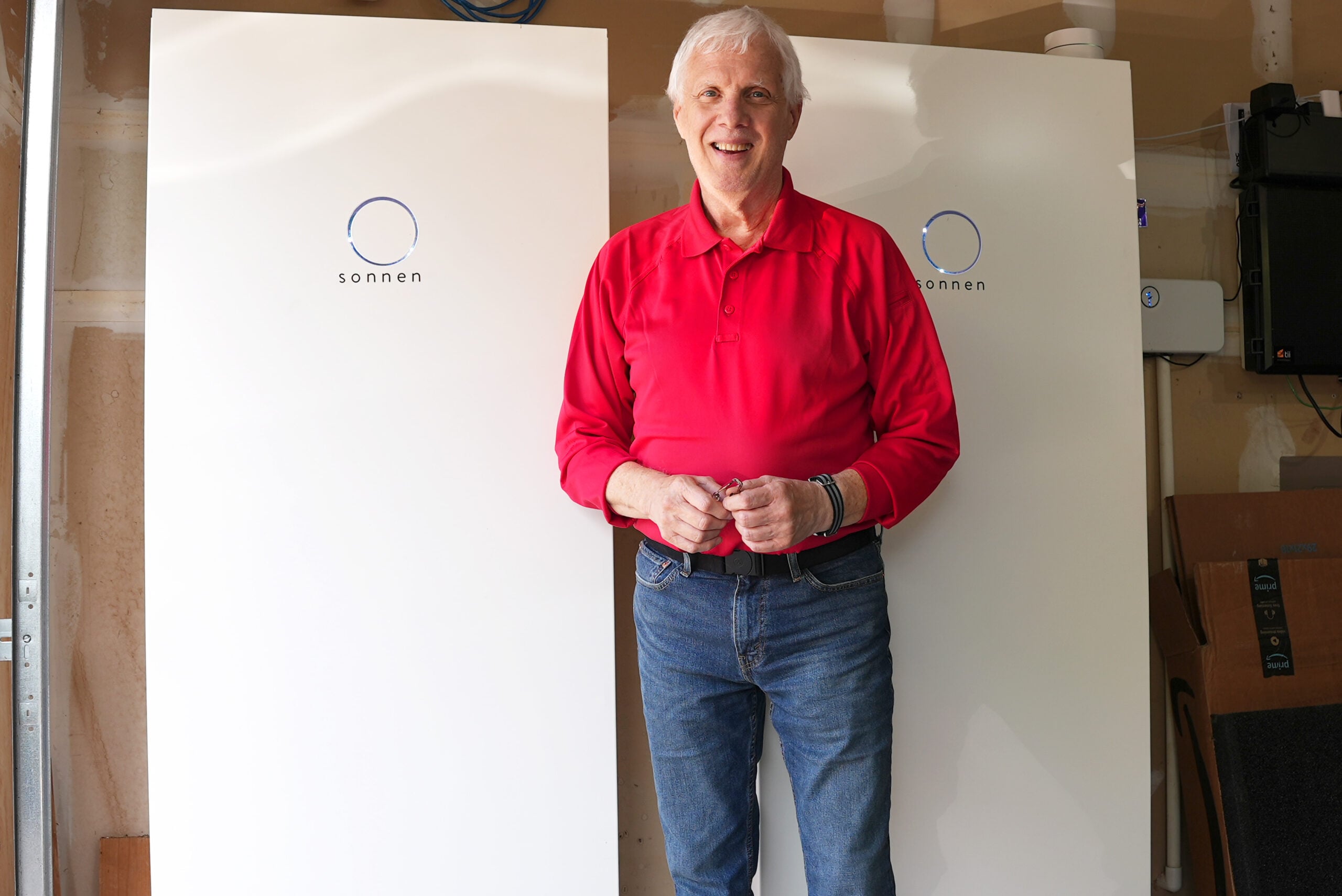
Usually the garage. They can't sit out in the weather and they take up real space. Worth walking out there and looking before you get to a site survey.
Not every house qualifies.
Heavy shade, an old roof, the wrong roofline. Sometimes the answer is no, and we'd rather find that out early than after you've cleared out the garage.
Who this doesn't work for
Renters, and mobile or manufactured homes.
Then there's your utility. Most of Texas is deregulated, which is why you can shop for a provider at all. But there are areas on a co-op or a regulated utility where you legally can't switch, and if that's where you live there's no version of this we can offer you. It takes about thirty seconds to check.
If you have an HOA, that's usually fine. We deal with them constantly and we handle that paperwork ourselves.
The battery is the other half
We've been talking about the bill, because that's probably why you're reading this. Worth knowing what else shows up in the driveway.
When the power goes out, the battery takes over. No fuel, no noise, no cord to drag out of the garage. On the battery alone, you're looking at up to 3 days of backup. The solar component keeps it topped off during the day, so on a normal cycle the system can run for up to 3 weeks instead of draining to nothing after the first outage.
How much of the house it carries, and for how long, comes down to your setup. That's an engineering question and we're not going to guess at it on a web page.
What happens if you want to look at it
A video call with one of our engineers. Google Meet, from your kitchen table. Nobody comes to your house for it.
Bring the bill. It's the one thing we genuinely need, because without it nobody can tell you your real rate or build you a design. If there's a spouse or a co-owner, get them on the call, because relaying this secondhand goes badly.
After that, if it looks like a fit, there's a free site survey. Somebody gets on the roof and checks the shade and the roofline and your panel. If the house doesn't pass, that costs you nothing. If it does, design and permits come next, and from approval to a working system is usually somewhere around forty five days.
Do the division first
Total bill divided by kilowatt hours used. If it comes out under twelve cents, you're in good shape and you should keep what you have.
If it's higher, we should probably talk.
Book the callBring your most recent electric bill. No commitment on the call.